Most conversations about glucose focus on what you eat. Rice or millet? Dal or no dal? How much fibre? These questions matter, but they miss something important: when you eat affects your glucose response independently of what is on your plate.
The same meal eaten at 7 PM and at 10 PM will produce different glucose readings. The same breakfast at 8 AM after a 12-hour fast and at 8 AM after a 9-hour fast will produce different results. Your body processes food differently depending on the time of day and how long it has been since your last meal.
This is not about extreme fasting diets. It is about eating in alignment with your body's natural rhythm.
Your Body Has a Glucose Clock
Your insulin sensitivity is not constant throughout the day. It follows a circadian rhythm - a 24-hour biological cycle that affects nearly every metabolic process.
Research from Stanford and other institutions has mapped this clearly:
- Morning: Insulin sensitivity is highest. Your body handles glucose most efficiently in the hours after waking. This is why the same meal at breakfast produces a lower spike than the same meal at dinner for many people.
- Afternoon: Insulin sensitivity remains good. Lunch is generally well-tolerated, especially with physical activity during the day.
- Evening: Insulin sensitivity drops. There is approximately a 30% reduction in insulin sensitivity in the evening compared to the morning. The same portion of rice that produced a 140 mg/dL peak at lunch might produce a 165 mg/dL peak at 9 PM.
- Night: Metabolic processes slow. Food eaten late at night faces the combined challenge of lower insulin sensitivity and reduced physical activity.
This circadian pattern explains a puzzle many people with prediabetes encounter: "I ate the same lunch and dinner, but my post-dinner glucose was much higher." It is not the food. It is the clock.
Time-Restricted Eating: The Research
Time-restricted eating (TRE) means consuming all your food within a defined window each day. It is not about eating less - it is about when you eat.
The most studied form for glucose management is early time-restricted eating, where the eating window falls earlier in the day. The research findings are striking:
- Early TRE (eating 8 AM to 4 PM): Produced a 15% reduction in fasting glucose and an 18% reduction in HbA1c over 5 weeks. This effect was nearly twice the impact of typical metformin dosing.
- Benefits occurred without calorie restriction. Participants ate the same amount of food; they simply ate it earlier.
- One week of TRE produced measurable reductions in glucose fluctuations.
A meta-analysis of intermittent fasting studies found that time-restricted eating produced an average weight loss of 1.87 kg plus a 2.08 cm reduction in waist circumference, along with improvements in total cholesterol, LDL, and triglycerides. But the glucose improvements were partly independent of weight loss, suggesting that the timing itself has metabolic benefits.
What This Means Practically
You do not need to follow a strict 8-hour eating window or skip meals. The practical takeaway from this research comes down to a few consistent patterns:
Finish dinner earlier. If you currently eat dinner at 9 PM, moving it to 7:30 PM gives your body an extra 90 minutes to process the meal before sleep. Late-night eating is associated with higher morning glucose because your body is trying to digest food when it should be in repair mode.
Maintain a consistent overnight fast. A 12-hour overnight fast - finishing dinner by 8 PM and eating breakfast at 8 AM - is the most practical starting point. This is modest and achievable for most people. It gives your liver time to clear glycogen stores and improves insulin sensitivity for the next day.
Do not skip breakfast. Despite the popularity of skipping breakfast in some fasting protocols, research consistently shows that breakfast eaters have better overall glucose control. Your body is most insulin-sensitive in the morning. Eating a reasonable breakfast takes advantage of that sensitivity.
Keep meal times consistent. Eating lunch at noon on Monday and 3 PM on Tuesday disrupts your body's preparation for digestion. Your pancreas anticipates meals based on habit. Consistent meal timing helps your insulin response match your food intake.
The Evening Meal Problem
For many families in India, dinner is the largest meal of the day and often the latest. A typical pattern: light breakfast, moderate lunch, heavy dinner at 9 or 9:30 PM. From a glucose perspective, this is exactly backwards.
You are eating the most food at the time when your body handles it worst. The combination of high carbohydrate load plus low evening insulin sensitivity plus reduced physical activity after dinner creates the conditions for elevated overnight glucose and a high fasting reading the next morning.
The research on the second-meal effect adds another dimension. What you eat for dinner affects your glucose response to breakfast the next morning. A dinner heavy in refined carbohydrates (plain white rice) produces both a high post-dinner glucose and an elevated fasting glucose the next morning and an exaggerated response to breakfast. A dinner with whole grains, dal, and vegetables moderates all three.
The magnitude of the second-meal effect can be 20-40 mg/dL difference in the next morning's fasting glucose. If your fasting readings are stubbornly high despite eating well during the day, your dinner composition and timing may be the primary factor.
A Practical Protocol
Here is a realistic approach to meal timing for someone managing prediabetes in India:
-
Breakfast by 8-9 AM. Take advantage of your body's peak insulin sensitivity. Include protein (eggs, dal, paneer) to moderate the glucose response.
-
Lunch by 1 PM. Your second most insulin-sensitive time of day. This can be your largest meal if preferred.
-
Dinner by 7:30 PM. Earlier is better, but 7:30 is realistic for most families and allows a 12-13 hour overnight fast. Make dinner moderate in size. Include dal and vegetables.
-
Nothing after dinner. No snacks, no fruit, no biscuits with tea. Water and unsweetened tea are fine. The overnight fast begins when you finish dinner.
-
Morning water or plain tea. When you wake, water or black tea or coffee without sugar does not break the fast. You can have this while preparing breakfast.
This protocol creates a natural 12-13 hour eating window without any extreme restriction. Over 2-4 weeks, many people see a measurable improvement in fasting glucose.
If you are comfortable with this pattern and your doctor agrees, you can gradually extend the overnight fast to 13-14 hours by either eating dinner slightly earlier or breakfast slightly later. The research suggests that 14-16 hour fasts produce additional benefits, but 12 hours is sufficient for meaningful improvement and is the safest starting point, especially if you are on any medication.
Important: If you take medication for blood sugar or blood pressure, discuss any change to your eating pattern with your doctor first. Fasting while on certain medications can cause dangerously low blood sugar.
How Prick Tracks Your Timing
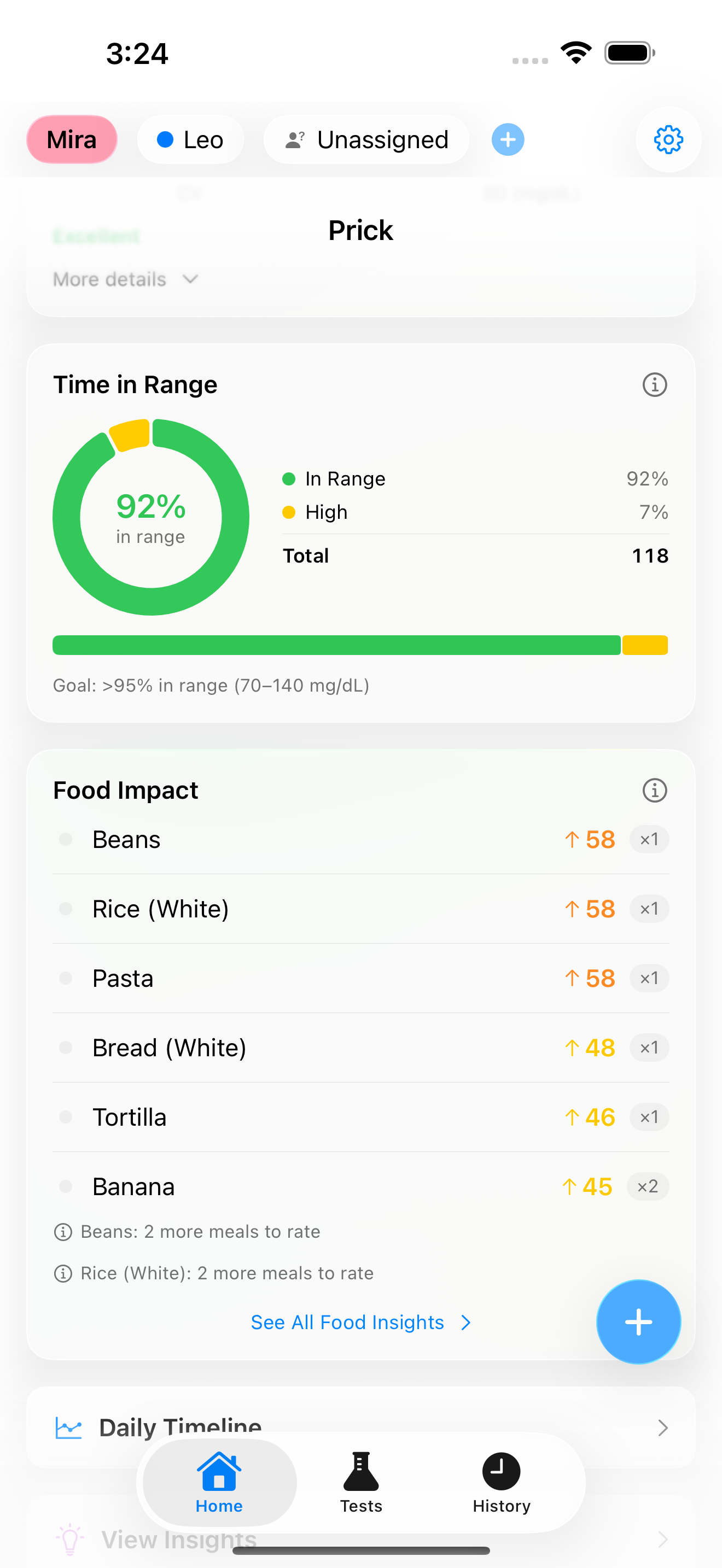
Prick records the timestamp of every meal you log. Over time, this builds a dataset that reveals your personal relationship between meal timing and glucose response. You can look at your fasting glucose trend alongside your dinner timestamps and see whether earlier dinners consistently produce lower morning numbers.
The fasting trend chart on the dashboard, with its 7, 14, and 30-day views, makes it easy to see whether timing changes are working. If you shift your dinner from 9 PM to 7:30 PM for two weeks, the trend line will tell you clearly whether it made a difference for your body.
The Key Takeaway
When you eat matters independently of what you eat. Your body processes glucose most efficiently in the morning and least efficiently at night. A consistent eating pattern with an adequate overnight fast, an earlier dinner, and a regular breakfast aligns your food intake with your circadian rhythm.
This is not about deprivation. It is about synchronisation. You are eating the same food, at times when your body can handle it best.
Based on: Sutton EF et al. (2018), early time-restricted feeding; circadian rhythm and glucose research; second-meal effect studies
View full citations
- Sutton EF, et al. "Early Time-Restricted Feeding Improves Insulin Sensitivity, Blood Pressure, and Oxidative Stress Even Without Weight Loss in Men With Prediabetes." Cell Metabolism. 2018;27(6):1212-1221. https://doi.org/10.1016/j.cmet.2018.04.010
- Wilkinson MJ, et al. "Ten-Hour Time-Restricted Eating Reduces Weight, Blood Pressure, and Atherogenic Lipids in Patients With Metabolic Syndrome." Cell Metabolism. 2020;31(1):92-104. https://doi.org/10.1016/j.cmet.2019.11.004
- Poggiogalle E, et al. "Circadian Regulation of Glucose, Lipid, and Energy Metabolism in Humans." Metabolism. 2018;84:11-27. https://doi.org/10.1016/j.metabol.2017.11.017
- Jenkins DJA, et al. "Metabolic Effects of Reducing Rate of Glucose Ingestion by Single Bolus Versus Continuous Sipping." Diabetes. 1990;39:775-781. https://doi.org/10.2337/diab.39.7.775
