You have probably been told to "eat healthy" and "exercise more." That advice is not wrong, but it is incomplete. It does not tell you whether brown rice is better than white rice for your body, or whether a 15-minute walk after lunch makes a meaningful difference to your glucose, or whether eating dal before rice actually reduces your spike.
The only way to answer those questions is to run your own experiments. This is not complicated. Scientists call it an N-of-1 trial, and it is one of the most powerful tools available for personalizing your glucose management.
What Is an N-of-1 Experiment?
The concept was formalized by Guyatt and colleagues in a 1986 paper in the New England Journal of Medicine. The idea is elegant: instead of studying 1,000 people and averaging their results, you study one person - yourself - and measure what works specifically for you.
An N-of-1 glucose experiment has a simple structure:
- Choose one thing to test (a food, an activity, a meal timing change)
- Set up two conditions: your normal way (Control) and the change you want to test (Test)
- Keep everything else the same between the two conditions
- Measure your glucose before and after each condition
- Repeat at least 3 times per condition to account for natural day-to-day variation
- Compare the results
That is it. No laboratory required. No special equipment beyond your glucometer.
Why Repetition Matters
Your glucose response to the same meal can vary by 5 to 15 mg/dL from one day to the next, even when conditions are similar. This is normal biological variation caused by differences in sleep quality, stress, hydration, and dozens of other factors.
If you test a new food once and get a reading of 155 mg/dL, you do not know whether that is the food's true effect or just a high-variation day. If you test it three times and get readings of 148, 155, and 151, now you know: your average response is about 151 mg/dL, and the result is reliable.
Research on N-of-1 methodology recommends a minimum of 3 repetitions per condition. With 3 runs of your Control and 3 runs of your Test, you have 6 total data points - enough to see whether a difference is real.
The 7 Experiments You Can Run Today
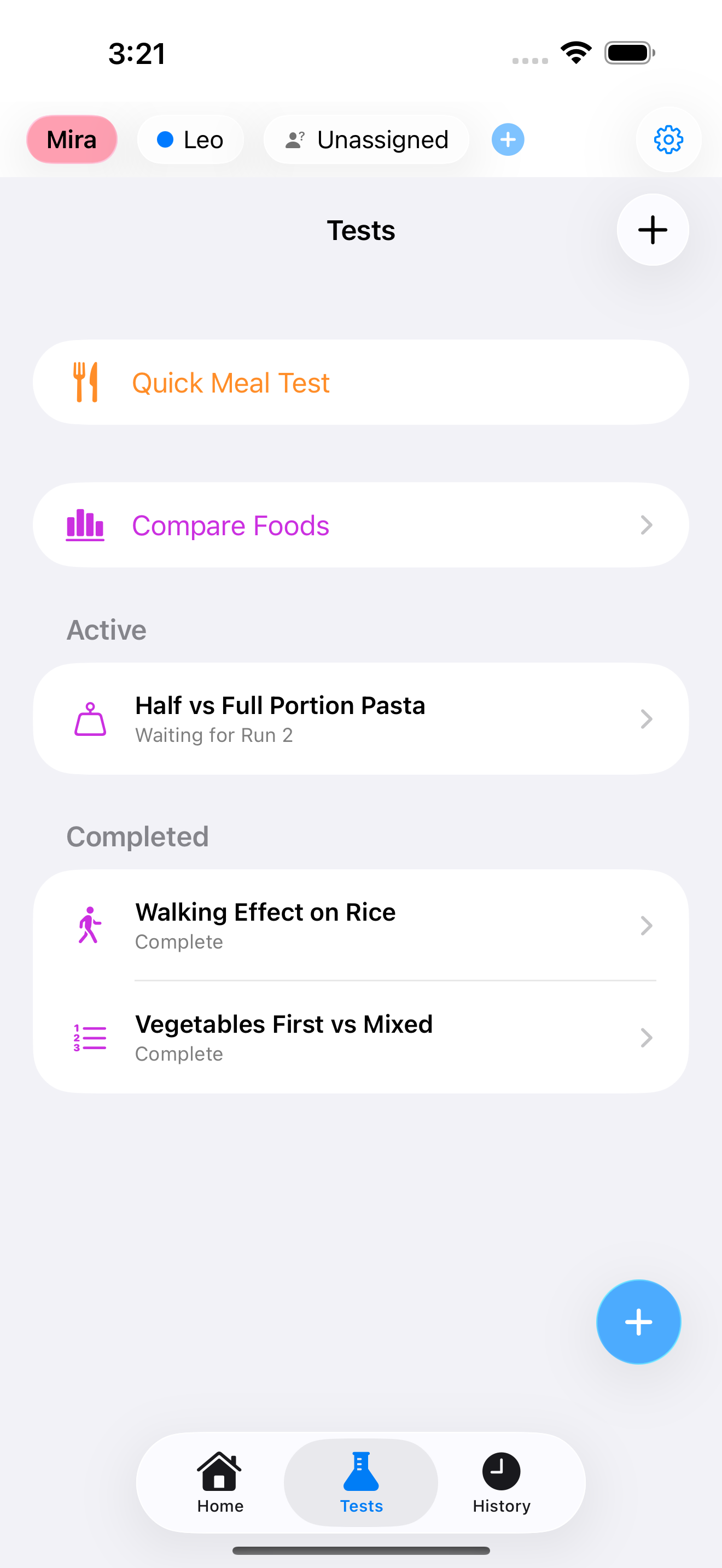
Prick includes templates for the experiments that research suggests have the highest impact for people managing prediabetes. Here is what each one tests and what you can expect to learn:
1. Walking Effect
The question: Does a walk after eating reduce my glucose spike?
How it works: Eat the same meal on two occasions. On one, sit normally after eating. On the other, take a 15-minute walk starting 30 minutes after your first bite. Measure glucose 2 hours after the meal on both days.
What research predicts: A post-meal walk typically blunts the glucose peak by 20-30%. A 30-minute walk can reduce it by 30-40%. Even a 3-minute walk produces a measurable benefit.
2. Carb Order
The question: Does eating vegetables and dal before rice reduce my spike?
How it works: Eat the same meal in two different orders. Control: eat everything mixed together or rice first. Test: eat vegetables and dal first, wait 10-15 minutes, then eat the rice.
What research predicts: Eating vegetables and protein before carbohydrates reduces the glucose peak by 25-40%. The fiber creates a viscous barrier that slows glucose absorption, and the protein triggers hormones that slow stomach emptying.
3. Portion Size
The question: How much rice can I eat while keeping my glucose in range?
How it works: Test different portions (for example, half a cup vs. one cup vs. one and a half cups of rice) with the same accompaniments, at the same time of day.
What research predicts: The relationship between portion and glucose response is not always linear. Many people find a threshold below which their glucose stays in range and above which it spikes sharply. This experiment helps you find yours.
4. New Food
The question: How does a food I have not tested before affect my glucose?
How it works: Compare the new food to a food whose effect you already know well (your baseline). Same portion of total carbohydrates, same time of day, same conditions.
What research predicts: Because individual glucose responses vary widely - the same food can cause a 40 mg/dL spike in one person and 120 mg/dL in another - you cannot rely on published GI tables to predict how your body will respond.
5. Fiber Pairing
The question: Does adding dal, vegetables, or other fibre-rich foods to a carb-heavy meal reduce the spike?
How it works: Test the same carbohydrate source (rice, dosa, bread) by itself versus paired with dal, vegetables, or both.
What research predicts: Adding protein and fibre to carbohydrates can lower the effective glycemic impact significantly. Research from the Madras Diabetes Research Foundation shows that rice plus dal lowers the effective GI by 15-20% compared to rice alone.
6. Consistency
The question: How reliable is my glucose response to a specific food?
How it works: Eat the same meal, at the same time, under the same conditions, on 3 to 5 different days. Measure your response each time.
What research predicts: If your readings cluster tightly (within 10-15 mg/dL of each other), your response to that food is predictable. If they are scattered, external factors like sleep, stress, or prior meals may be influencing the result.
7. Custom
Design your own experiment. Test anything with two conditions - medication timing, meal timing, specific food swaps, weekend versus weekday eating patterns.
How to Control for Confounders
The biggest threat to a useful experiment is changing more than one thing at a time. If you switch to millet dosa AND start walking after meals, and your glucose improves, you will not know which change caused the improvement.
Keep these variables consistent between your Control and Test runs:
- Time of day: Test the same meal at the same time. Morning insulin resistance means breakfast readings are typically higher than lunch readings, even for the same food.
- Sleep: A night of poor sleep can elevate next-day glucose by 10-20 mg/dL. Try to compare days with similar sleep quality.
- Stress: High-stress days can raise glucose by 15-30 mg/dL across all readings.
- Activity: Keep your activity level similar on Control and Test days.
- Portions: Weigh or measure your food. "About one cup of rice" is not precise enough - use a measuring cup.
You do not need perfect control. You need reasonable consistency across 3 or more repetitions. The repetition itself smooths out the noise from imperfect control.
When the Results Tell You Something
A difference of 10 mg/dL or more between your Control and Test averages is considered meaningful, given the normal day-to-day variation of 5-8 mg/dL. A consistent difference across 3 repetitions is reliable.
When you find something that works - a food swap that drops your spike by 20 mg/dL, a walk that cuts your peak by 30% - you have evidence that is specific to your body. That is more valuable than any generic dietary guideline.
Based on: Guyatt et al. (1986), N-of-1 Trials in Individual Patients; Paired Meal Testing Methodology; ADA Structured SMBG Guidelines
View full citations
- Guyatt G, et al. "Determining Optimal Therapy - Randomized Trials in Individual Patients." New England Journal of Medicine. 1986;314(14):889-892. https://doi.org/10.1056/NEJM198604033141406
- Polonsky WH, et al. "Structured Self-Monitoring of Blood Glucose Significantly Reduces A1C Levels in Poorly Controlled, Noninsulin-Treated Type 2 Diabetes." Diabetes Care. 2011;34(2):262-267. https://doi.org/10.2337/dc10-1732
- Zeevi D, et al. "Personalized Nutrition by Prediction of Glycemic Responses." Cell. 2015;163(5):1079-1094. https://doi.org/10.1016/j.cell.2015.11.001
- Shukla AP, et al. "Food Order Has a Significant Impact on Postprandial Glucose and Insulin Levels." Diabetes Care. 2015;38(7):e98-e99. https://doi.org/10.2337/dc15-0429
