If you have been told you have prediabetes, someone has almost certainly told you to stop eating rice. That advice, while well-intentioned, ignores the reality of Indian food culture. Rice is not just a carbohydrate. It is part of how families eat together, how meals are structured, and how comfort is expressed. Telling someone in Bangalore to stop eating rice is like telling someone in Italy to stop eating pasta. It is not realistic, and more importantly, it is not necessary.
The science does not say "stop eating rice." It says eat it smarter. And there are specific, well-researched strategies that can reduce your glucose spike from rice by 20 to 40 mg/dL without removing it from your plate.
The Real Problem With Rice
White rice has a high Glycaemic Index (GI) of 73 to 78. GI measures how quickly a food raises your blood glucose on a scale of 0 to 100. For context, pure glucose scores 100. So white rice is in the upper range - it breaks down quickly and sends glucose into your bloodstream fast.
But GI is only part of the story. A landmark study from the Madras Diabetes Research Foundation (Mohan et al., 2010) tested brown rice, white rice, and brown rice with legumes in overweight Asian Indians. The results showed clearly: it is not just the rice itself that matters, it is what you eat with it and how much you eat.
Here is how rice varieties compare:
- White rice (polished): GI 73-78. One cup of cooked white rice alone can push post-meal glucose to 175-190 mg/dL.
- Brown rice: GI 58-70. Peak glucose is typically 150-165 mg/dL - about 15% lower.
- White basmati rice: GI 60-69. Better than standard white rice due to longer grain structure.
- Foxtail millet (navane/thinai): GI around 50. Peak glucose drops to 130-150 mg/dL - 25 to 30% lower than white rice.
Four Strategies That Actually Work
1. Pair Rice With Dal
This is the most effective and most culturally natural strategy. When you eat rice with dal, the protein and fibre from the dal slow down how quickly the rice is digested and absorbed. ICMR research on Indian rice-dal combinations confirms that this pairing lowers the effective GI of the meal by 15 to 20%.
The numbers are striking. One cup of white rice alone produces a peak glucose of 175-185 mg/dL. The same cup of rice eaten with half a cup of dal and a serving of vegetables, in the right order, produces a peak of 120-135 mg/dL. That is a difference of 40 to 50 mg/dL from the same amount of rice.
The ideal ratio: for every cup of rice, eat at least half a cup of cooked dal. More dal is better. Think of dal as the foundation of the meal, not a small accompaniment.
2. Control Your Portion
Typical Indian rice portions at lunch or dinner are 2 to 2.5 cups of cooked rice, which contains 90 to 110 grams of carbohydrates. Reducing this to 1 to 1.5 cups (45-67g of carbs) drops the peak glucose by 20 to 30 mg/dL on its own.
The trick to making this feel satisfying is to fill the space with more dal, more sambar, more vegetables. You are not eating less food. You are changing the proportions.
3. Choose a Better Variety
You do not need to switch completely to brown rice on day one. Start by mixing: half white rice, half foxtail millet, or half brown rice. The blended version tastes familiar but has a meaningfully lower GI. Over time, your palate adjusts.
If brown rice feels too different, try white basmati. It has a lower GI than standard white rice (GI 60-69 vs 73-78) and has a pleasant texture many people prefer.
4. Use the Cooling Trick
When cooked rice is cooled - for example, by refrigerating leftover rice overnight - some of its starch converts into resistant starch. This is a form of starch that your body digests more slowly, which means a more gradual glucose rise. The GI reduction is approximately 10 to 15%.
This is good news for anyone who cooks a large batch of rice at dinner and uses the leftovers for the next meal. Curd rice, which is traditionally made with cooled rice, actually has a built-in glucose benefit that our grandmothers may not have known about but instinctively practiced.
How Prick Helps You Find Your Rice Threshold
Everyone responds to rice slightly differently. Your body's response to one cup of white rice with sambar might be different from someone else's. That is why personal testing matters more than generic advice.
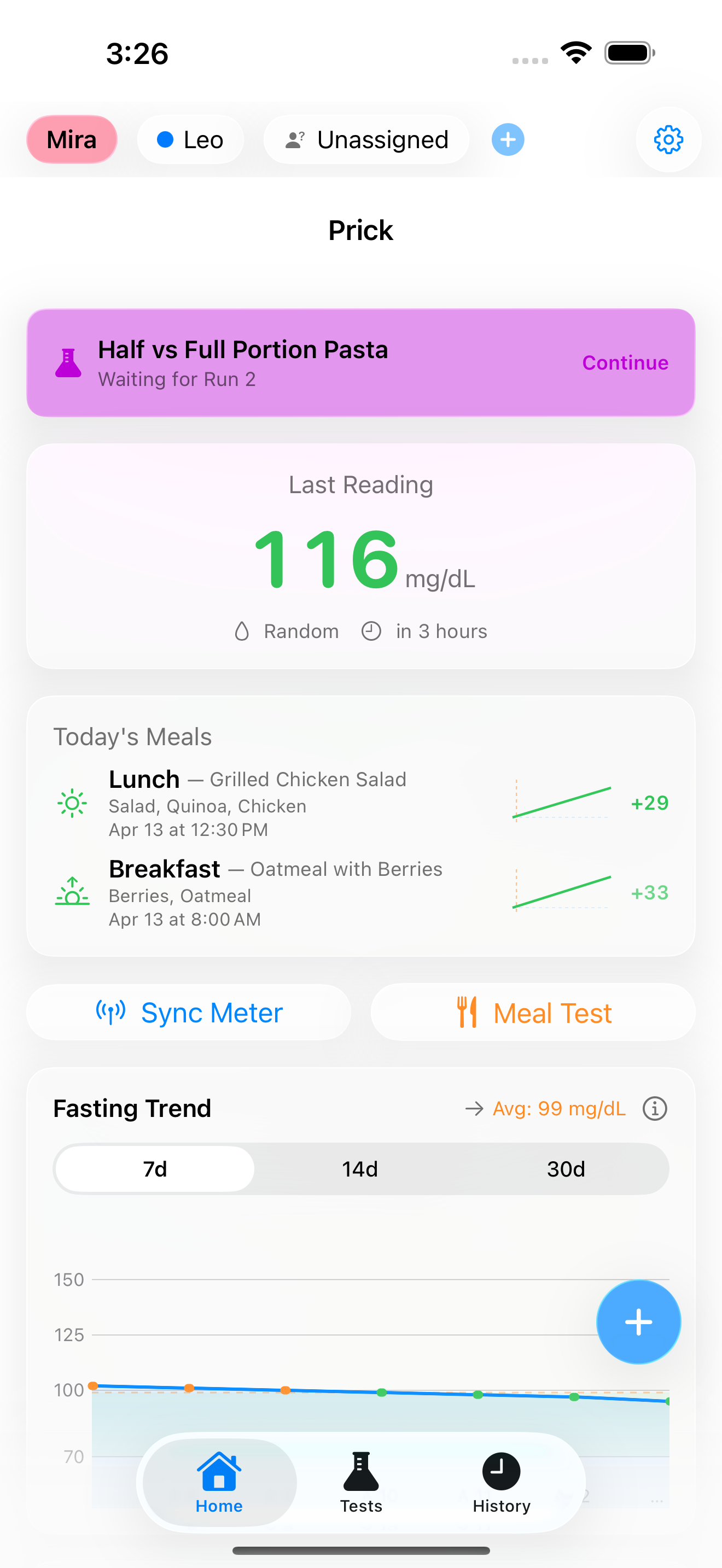
Prick's meal tracking lets you log exactly what you ate - with specific food tags for rice type, dal, vegetables, and portion - and see the resulting glucose spike. The experiment feature takes this further: you can run a structured paired meal test. Eat your usual rice portion on one day, measure your spike. Try brown rice or a smaller portion with extra dal on another day, same time, same conditions. Compare the results side by side.
Most people find that one or two specific changes make the biggest difference for their body. For some, it is switching to foxtail millet. For others, it is simply adding more dal. The app helps you find your personal answer.
The Bottom Line
Rice is not the enemy. Large portions of plain white rice, eaten quickly without dal or vegetables, is the pattern that causes problems. Change the variety, control the portion, pair it with dal, and eat it last - and your glucose response will look very different.
You do not need to eat foreign foods or go on a special diet. You are eating better versions of your own food: a little more dal, a little less rice, the same spices, the same structure. This is sustainable because it is your food, prepared your way.
Based on: Mohan V et al. (2010), Madras Diabetes Research Foundation brown rice study; ICMR Carbohydrate Profiling Study; Lal et al. (2021), resistant starch in rice; Sathyasurya et al. (2009), GI of Indian foods
View full citations
- Mohan V, et al. "Effect of Brown Rice, White Rice, and Brown Rice with Legumes on Blood Glucose and Insulin Responses in Overweight Asian Indians." Journal of the American Dietetic Association. 2010;110(10):1474-1479. https://doi.org/10.1016/j.jada.2010.07.001
- Sathyasurya DR, et al. "Glycaemic Index of Some Commonly Consumed Indian Foods." International Journal of Food Sciences and Nutrition. 2009. PMID: 19234937
- Lal MK, et al. "Resistant Starch in Rice: Implications for Human Nutrition." Comprehensive Reviews in Food Science and Food Safety. 2021. https://doi.org/10.1111/1541-4337.12704
- ICMR Task Force Study on Prevention and Control of Diabetes. "Dietary Practices for Prevention of Type 2 Diabetes in India." Indian Journal of Medical Research. 2009;130:540-546. PMID: 20090101
- Shobana S, et al. "Glycaemic Index of Indian Flat Breads (Rotis) Prepared Using Whole Wheat Flour and 'Atta Mix' - Added Whole Grain Cereals and Pulses." British Journal of Nutrition. 2011;105(1):71-77. https://doi.org/10.1017/S0007114510003089
