Imagine two people, both with an average glucose of 115 mg/dL. On paper, they look identical. But Person A's readings stay between 100 and 130 all day. Person B swings from 70 in the afternoon to 180 after dinner, then crashes back down.
Their averages are the same. Their metabolic health is not.
Research over the past two decades has established that glucose variability - how much your blood sugar swings up and down - is an independent risk factor for cardiovascular complications, even when average glucose is well-controlled. In other words, it is not just the destination that matters. It is the ride.
What Glucose Variability Actually Measures
Variability is about the size and frequency of fluctuations. Three metrics capture different aspects of it:
CV: Coefficient of Variation
This is the most widely used and recommended variability metric. It measures how spread out your readings are as a percentage of your average:
CV = (Standard Deviation / Mean glucose) x 100%
For example, if your mean glucose is 120 mg/dL and your standard deviation is 30 mg/dL, your CV is 25%.
The international consensus thresholds:
- Below 25% - Excellent stability. Your glucose is predictable and well-controlled.
- 25 to 30% - Good. Minor adjustments to diet or timing may help.
- 30 to 36% - Moderate variability. Worth identifying triggers like specific foods, sleep quality, or stress.
- Above 36% - High variability. This level is associated with increased cardiovascular risk and warrants attention.
CV is considered more useful than standard deviation alone because it accounts for differences in baseline glucose level. A person with a mean glucose of 90 and SD of 20 has very different variability (CV 22%) than someone with a mean of 150 and SD of 20 (CV 13%), even though the absolute swings are the same.
MAGE: Mean Amplitude of Glycemic Excursions
MAGE measures the average size of significant glucose swings within a single day. It works by identifying all peaks and troughs that exceed one standard deviation from the mean, then averaging their amplitudes.
Think of it as answering the question: "On a typical day, how big are my glucose roller-coaster rides?"
- Below 40 mg/dL - Good. Your within-day swings are modest.
- 40 to 60 mg/dL - Moderate.
- 60 to 80 mg/dL - Elevated variability.
- Above 80 mg/dL - High. Large glucose swings are occurring regularly.
MODD: Mean of Daily Differences
MODD captures day-to-day consistency by comparing your glucose at the same time on consecutive days. If your fasting glucose is 98 on Monday and 115 on Tuesday, that 17 mg/dL difference contributes to your MODD score.
- Below 20 mg/dL - Excellent day-to-day consistency.
- 20 to 35 mg/dL - Good.
- 35 to 50 mg/dL - Moderate. Your daily patterns are not very consistent.
- Above 50 mg/dL - High. Something is varying significantly between days (diet, sleep, stress, activity).
Why Swings Are Worse Than Steady Elevation
The research here is compelling. Ceriello and colleagues demonstrated that oscillating glucose levels are more damaging to endothelial function (blood vessel lining) and generate more oxidative stress than a constant glucose level - even when the constant level is higher.
This means that wild swings between 70 and 180 mg/dL can be harder on your cardiovascular system than a steady 130 mg/dL, even though the swinging pattern has a lower average.
The international consensus on continuous glucose monitoring, established by Danne and colleagues in 2017 and endorsed by the American Diabetes Association and multiple international bodies, formally recommended CV as a key metric alongside Time in Range and mean glucose. High variability is now recognized as an independent risk marker, not just a statistical curiosity.
The GRI: A Single Score for Overall Risk
The newest metric in this space is the Glycemia Risk Index (GRI), developed to address a limitation of older metrics: they tend to look at either highs or lows, not both. GRI combines hypoglycemia risk and hyperglycemia risk into a single composite score, weighted by clinical severity.
The formula weights severe lows most heavily (because they are the most immediately dangerous), then moderate lows, then high glucose, then moderate highs:
- Below 20 - Optimal glycemic control
- 20 to 35 - Good control
- 35 to 50 - Moderate risk
- Above 50 - High risk requiring attention
For people with prediabetes who are not on insulin, the hyperglycemia component of GRI is typically more relevant than the hypoglycemia component, since severe lows are rare without insulin-stimulating medications.
What Causes High Variability (And How to Reduce It)
The most common drivers of glucose variability in prediabetes are not mysterious:
Inconsistent meal composition. Eating a high-carb meal followed by a low-carb meal, or skipping meals entirely, creates the kind of rollercoaster pattern that drives up CV. Consistent meals at consistent times is one of the most effective ways to improve variability.
High-carb meals without protein or fibre. A plate of white rice alone produces a steep spike followed by a rapid decline. The same rice paired with dal and vegetables produces a gentler, slower curve. The total carbohydrates might be similar, but the variability is dramatically different.
Irregular sleep. Poor sleep increases next-day glucose variability through cortisol dysregulation. Consistent sleep timing matters more than total hours.
Stress. Acute stress can raise glucose by 15-30 mg/dL. Chronic stress creates sustained variability that shows up as an elevated CV over weeks.
Skipping post-meal activity. A short walk after meals blunts the peak, which directly reduces the amplitude of glucose swings.
What You Can Do
The goal is not to obsess over every reading, but to identify the patterns that drive your largest swings and address them:
- Check which meals produce the widest excursions and compare them to your calmer days. Is the difference the food, the timing, or something else?
- Eat at consistent times each day. Circadian alignment improves insulin sensitivity and reduces fasting variability.
- Pair carbohydrates with protein, fat, and fibre at every meal. This buffers both the rise and the fall, smoothing out the curve.
- A short walk after your highest-carb meal of the day can reduce that meal's spike by 20-30%, directly lowering your daily MAGE.
How Prick Shows You the Full Picture
The Prick dashboard shows your CV and Standard Deviation on the Glucose Stability card, updated as new readings come in. Tap for more details and you see MAGE (within-day swings) and MODD (day-to-day consistency).
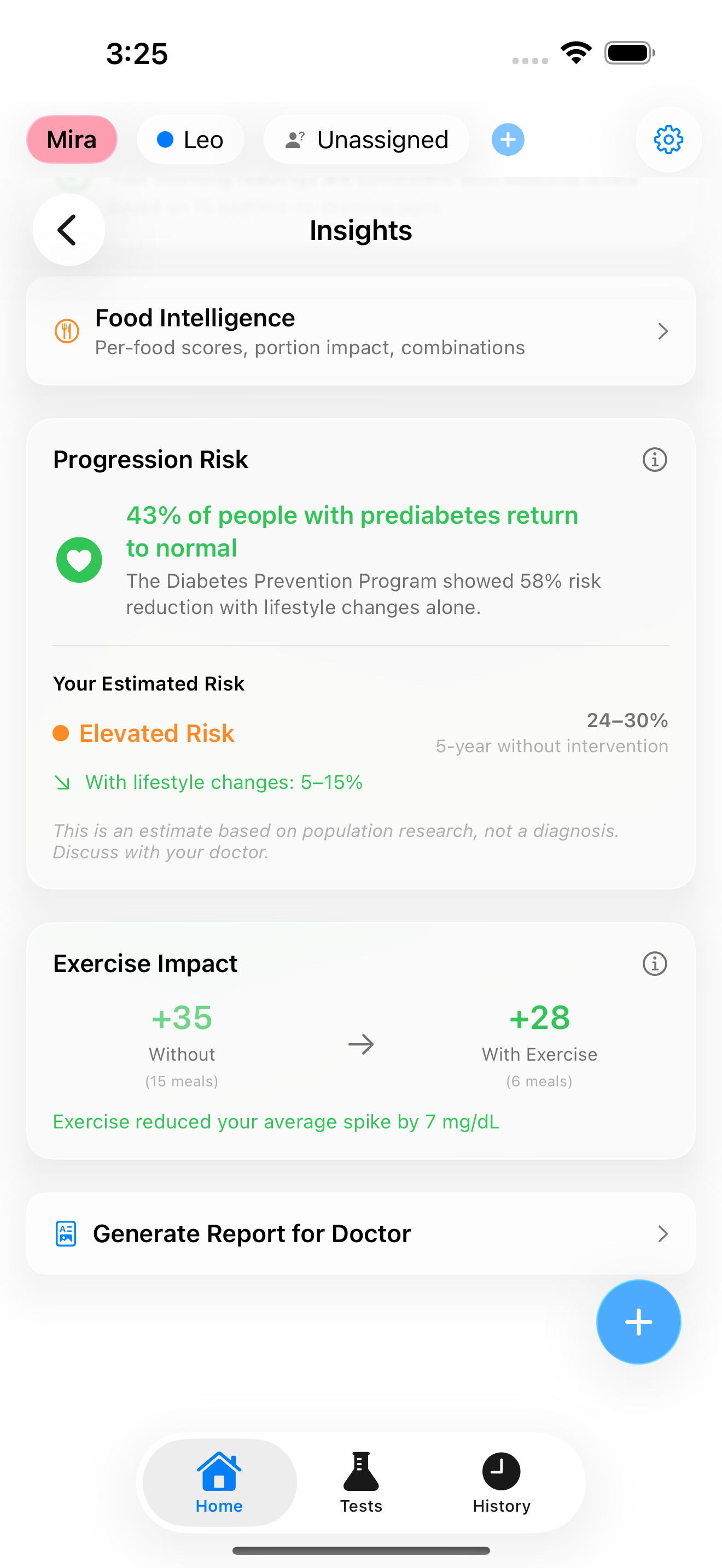
In the Insights hub, the Risk Assessment section displays your LBGI and HBGI scores alongside the GRI composite. The Variability Deep Dive breaks down your MAGE and MODD trends over time, so you can see whether your stability is improving as you make changes.
A glucose average tells you where you are. Variability metrics tell you how you are getting there. Both matter, and together they give you a far more complete picture of your metabolic health than either one alone.
Based on: Danne et al. (2017), International Consensus on CGM; Ceriello et al. (2008), Oscillating Glucose and Oxidative Stress; GRI Composite Metric Research
View full citations
- Danne T, et al. "International Consensus on Use of Continuous Glucose Monitoring." Diabetes Care. 2017;40(12):1631-1640. https://doi.org/10.2337/dc17-1600
- Ceriello A, et al. "Oscillating Glucose Is More Deleterious to Endothelial Function and Oxidative Stress Than Mean Glucose in Normal and Type 2 Diabetic Patients." Diabetes. 2008;57(5):1349-1354. https://doi.org/10.2337/db08-0063
- Rodbard D. "Interpretation of Continuous Glucose Monitoring Data: Glycemic Variability and Quality of Glycemic Control." Diabetes Technology & Therapeutics. 2009;11(Suppl 1):S55-S67. https://doi.org/10.1089/dia.2008.0132
- Battelino T, et al. "Clinical Targets for Continuous Glucose Monitoring Data Interpretation: Recommendations From the International Consensus on Time in Range." Diabetes Care. 2019;42(8):1593-1603. https://doi.org/10.2337/dci19-0028
