There is a food that most Indian families already eat every day, that has some of the lowest glucose impact of any food measured, and that actively reduces the glucose spike from other foods when combined in the same meal. It is dal - and if you are managing prediabetes, it is the most effective dietary tool already sitting in your kitchen.
This is not about adding something exotic to your diet. It is about understanding what you already eat, and leaning into it.
Why Dal Is So Effective
Dal and legumes have a Glycaemic Index (GI) of 20 to 32, depending on the type. For comparison, white rice has a GI of 73 to 78. That is not a small difference. Dal is in the very low GI category, which means it releases glucose into your bloodstream slowly and steadily rather than in a sharp spike.
The reason for this low GI is the combination of protein and soluble fibre in every serving:
- Protein: 8 to 12 grams per half cup of cooked dal. Protein slows gastric emptying, meaning food spends more time in your stomach and less glucose enters your bloodstream at once.
- Fibre: 4 to 6 grams per half cup. Soluble fibre forms a gel-like substance in your intestine that physically slows glucose absorption.
Together, these two mechanisms create what researchers call a "blunting effect" on the meal's total glucose response.
The GI of Common Indian Dals
Not all dals are the same. Here is how they rank:
- Masoor dal (red lentils): GI 21-30. Cooks quickly, mild flavour, excellent glucose profile.
- Chana dal (split chickpeas): GI 22-32. Hearty texture, slightly nuttier flavour.
- Moong dal: GI 25-35. Light, easy to digest, very versatile.
- Chole/chickpeas (kabuli chana): GI 28-35. Higher protein (15g per cup).
- Rajma (kidney beans): GI 28-40. Satisfying and filling.
- Toor/arhar dal: GI 30-40. Staple of sambar across South India.
All of these are excellent choices. The differences between them are less important than the simple fact of eating more of any of them.
What Happens When You Combine Dal With Rice
ICMR research specifically tested Indian rice-dal combinations and found that adding dal to rice reduces the effective GI of the meal by 15 to 20%. In practical terms:
- 1 cup of rice alone: Peak glucose of 175-185 mg/dL
- 1 cup of rice + half cup of dal: Peak glucose drops to 140-155 mg/dL
- 1 cup of rice + half cup of dal + vegetables (eaten in order): Peak glucose of 120-135 mg/dL
That last number, 120 to 135 mg/dL, is within the target range for prediabetes management. And you are still eating rice.
The mechanism is straightforward: dal's protein and fibre slow down the digestion of rice's carbohydrates, spreading the glucose release over a longer period. Instead of a sharp peak, you get a gradual rise and a gentler return to baseline.
The Second Meal Effect
There is another benefit of dal that most people do not know about. Researchers call it the "second meal effect," first described by Jenkins and colleagues in landmark research on lentils and glycaemic response. Here is what it means: when you eat a low-GI food like dal at one meal, it improves your glucose response to the next meal, even if that next meal is high-GI.
In practical terms: eating a generous portion of dal at lunch can improve your dinner glucose response. Eating dal at dinner can improve your fasting glucose the next morning and moderate your breakfast spike.
The research shows that this effect can reduce the glucose peak of the following meal by 20 to 40 mg/dL. It lasts 12 to 24 hours. The mechanism involves sustained suppression of free fatty acids and improved insulin sensitivity that carries forward from one meal to the next.
This is why researchers studying Indian diets consistently recommend increasing dal consumption as a first-line dietary change for prediabetes.
How to Eat More Dal (Without Changing Your Meals)
The good news is that dal fits naturally into every Indian meal format. You are not adding something unfamiliar. You are increasing something you already know:
- Double your sambar portion at lunch. Instead of one ladle, take two. The extra dal and vegetables from sambar will buffer the rice that follows.
- Add a separate dal curry as a side. A simple masoor dal with a tadka of mustard seeds and curry leaves takes 15 minutes to prepare and delivers the full glucose-lowering benefit.
- Cook dal into your rice. Khichdi - rice and moong dal cooked together - is a complete meal with a much lower effective GI than plain rice.
- Try legume-based dishes more often. Chana masala, rajma curry, pesarattu (moong dal dosa) - these are all culturally familiar foods that happen to be excellent for glucose management.
- Start meals with dal. Eat your sambar or dal curry before touching the rice. The protein and fibre will be waiting in your intestine when the carbohydrates arrive.
Testing Your Dal Strategy With Prick
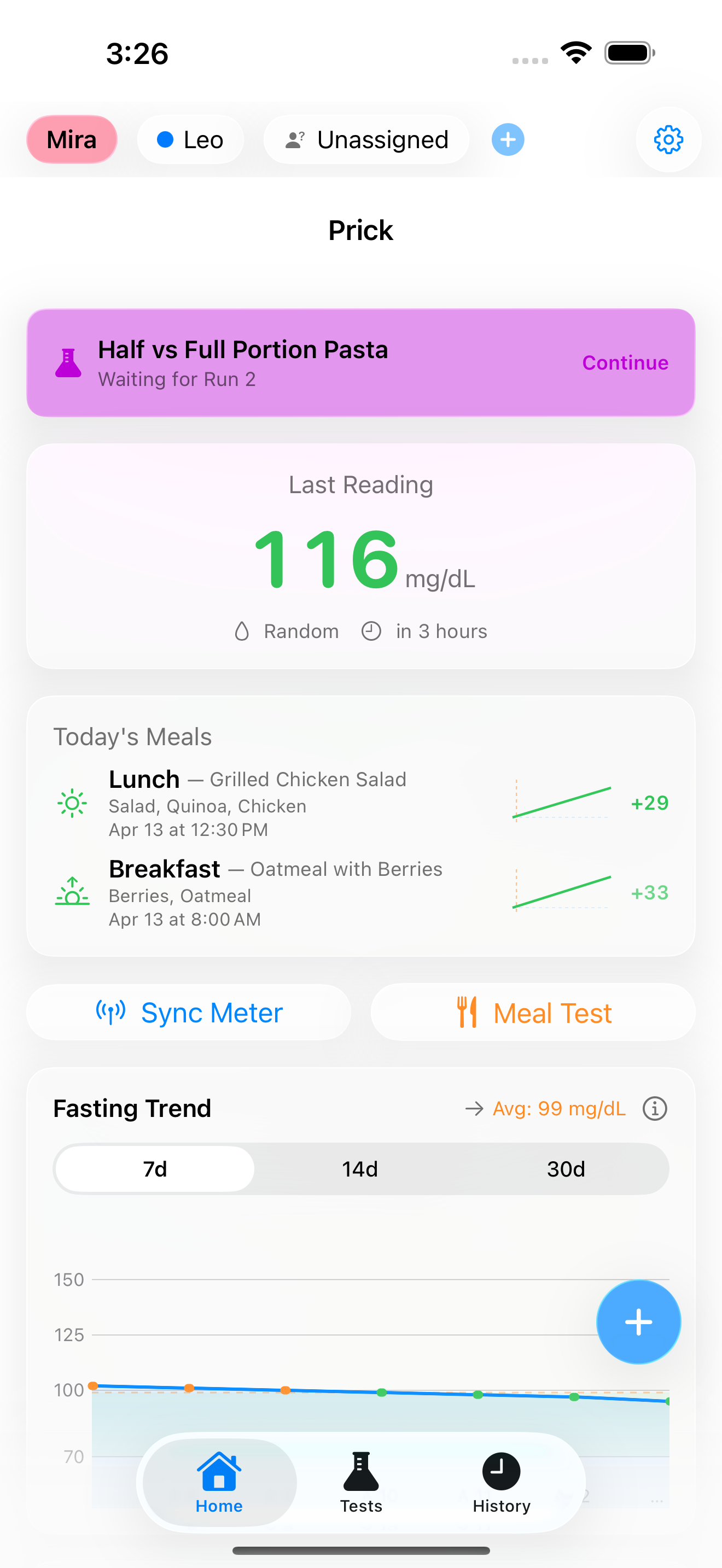
Everyone's response to dal is slightly different, and the specific combination that works best for you depends on your body. Prick's food logging lets you tag meals with specific dal types and portions so you can see exactly how different dal combinations affect your spike.
Try a simple experiment: eat your usual meal with your current dal portion, and log it. Two days later, eat the same meal with double the dal. Compare the post-meal readings. Most people see a 15 to 25 mg/dL difference - visible and meaningful.
The Bottom Line
You do not need to discover some new superfood to manage your glucose. The most effective glucose-lowering food in the Indian diet has been sitting on your table at every meal for generations. Dal is inexpensive, widely available, endlessly versatile, and scientifically proven to reduce glucose spikes when paired with rice.
The simplest dietary advice for prediabetes management in India might be this: eat more dal.
Based on: Jenkins DJ et al. (1982), lente carbohydrate research; ICMR Task Force Study on Diabetes Prevention; Sathyasurya et al. (2009), GI of Indian foods; research on the second meal effect from whole grains and legumes
View full citations
- Jenkins DJ, et al. "Lente Carbohydrate: A Newer Approach to the Dietary Management of Diabetes." Diabetes Care. 1982;5(6):634-641. https://doi.org/10.2337/diacare.5.6.634
- Jenkins DJ, et al. "Slow Release Dietary Carbohydrate Improves Second Meal Tolerance." American Journal of Clinical Nutrition. 1982;35(6):1339-1346. https://doi.org/10.1093/ajcn/35.6.1339
- ICMR Task Force Study on Prevention and Control of Diabetes. "Dietary Practices for Prevention of Type 2 Diabetes in India." Indian Journal of Medical Research. 2009;130:540-546. PMID: 20090101
- Sathyasurya DR, et al. "Glycaemic Index of Some Commonly Consumed Indian Foods." International Journal of Food Sciences and Nutrition. 2009. PMID: 19234937
- Dahl WJ, Foster LM, Tyler RT. "Review of the Health Benefits of Peas (Pisum sativum L.)." British Journal of Nutrition. 2012;108(Suppl 1):S3-S10. https://doi.org/10.1017/S0007114512000852
